

Nerf Vortex Aero Howler Foam Football Review
Aerodynamic Foam Football with Howling Whistle Sound for Maximum Distance
Analysis
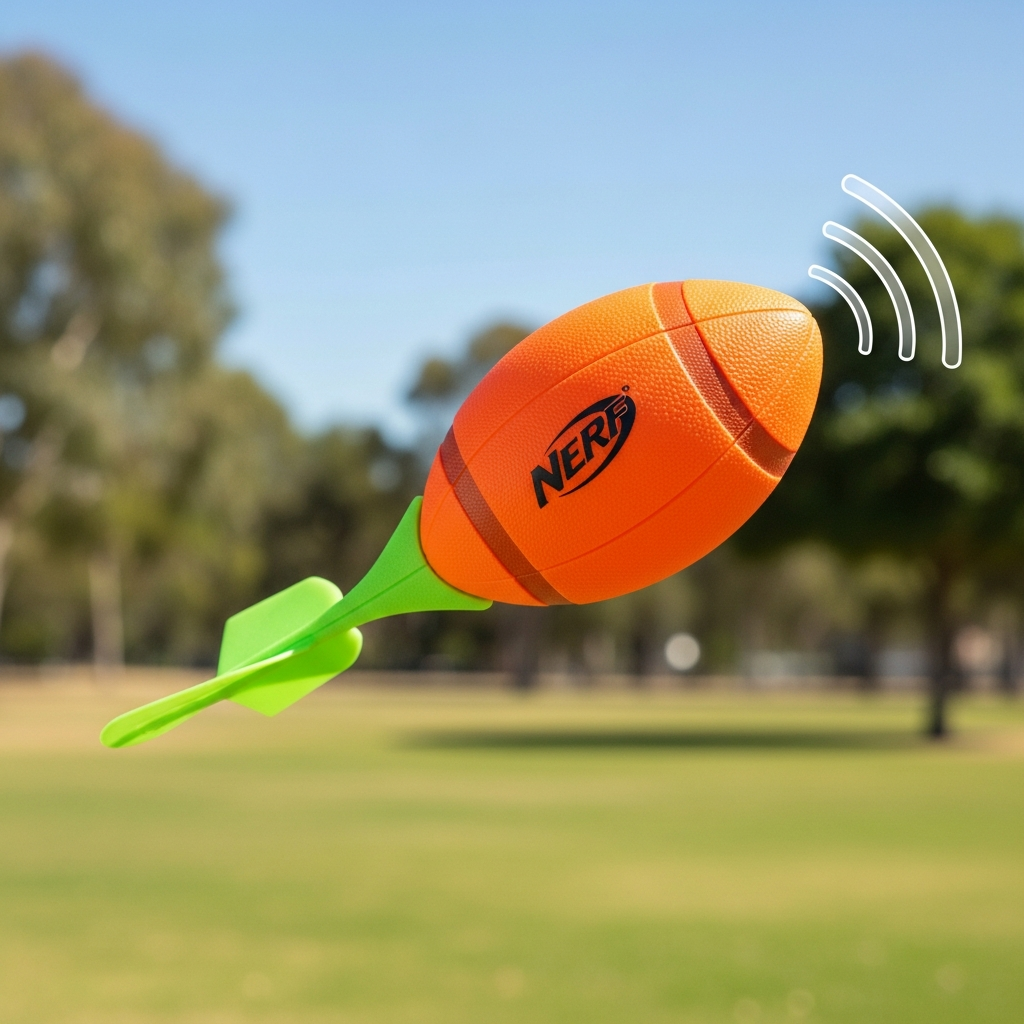
The Nerf Vortex Aero Howler represents Nerf’s innovative approach to foam football design, featuring a unique three-finned aerodynamic tail and integrated air channels that produce distinctive whistling sound during flight[web:996][web:1000]. Measuring approximately 12.25 inches in length with distinctive torpedo-like profile, the Aero Howler departs from traditional football shape to optimize long-distance throwing capability and flight stability[web:996]. The foam construction maintains Nerf’s commitment to safe play while the engineered airflow design enables throwing distances significantly exceeding conventional foam footballs—experienced throwers ages 10 and up achieve 40-60 foot distances compared to 20-30 feet typical of standard foam footballs. The $15-25 pricing positions it as premium foam football option targeting children ages 6 and up seeking enhanced outdoor throwing experience with unique auditory feedback[web:995][web:996].
Construction utilizes lightweight foam material weighing only 5.6 ounces, significantly lighter than regulation footballs while maintaining sufficient mass for stable flight trajectories[web:996]. The foam density strikes balance between softness preventing injuries during errant throws and firmness providing structural integrity for the integrated tail fins. The three-finned tail extends approximately 4 inches from the rear of the football, with each fin angled precisely to generate stabilizing spin during flight similar to arrow fletching or rocket fins[web:996]. These fins transform the throwing motion into rotational stability that keeps the projectile oriented nose-first throughout flight, dramatically reducing wobble and maintaining velocity over extended distances compared to finless foam footballs that tumble unpredictably.
The integrated air channel system represents the Aero Howler’s signature feature, incorporating strategically positioned holes through the tail section that channel airflow during flight[web:996][web:1000]. As the football travels through air at sufficient velocity—typically requiring throwing speeds exceeding 20 mph—air rushes through these channels creating resonant whistling effect that produces the distinctive “howling” sound giving the product its name[web:996]. The whistle intensity correlates directly with throwing velocity, providing auditory feedback about throw power while creating entertainment value that captures children’s attention beyond simple catching games. However, weak or slow throws fail to generate sufficient airflow for audible whistling, disappointing younger children ages 6-7 who lack arm strength for whistle-activating velocities.
The molded hand grip integrated into the foam body provides ergonomic throwing surface positioned approximately one-third back from the nose[web:996]. The grip features subtle finger channels and textured surface enhancing purchase during throwing motion, enabling secure hold even when hands are sweaty from active play. The grip positioning encourages proper weight distribution during throws, naturally promoting technique that generates the nose-forward orientation required for maximum distance and whistle activation. However, the unconventional shape means traditional spiral throwing technique doesn’t translate directly—throwers must adapt to the torpedo-like profile which requires different release mechanics compared to regulation football spirals.
Durability engineering focuses on outdoor play resilience through closed-cell foam construction resistant to water absorption and compression[web:996]. The foam maintains structural integrity after ground impacts on grass, dirt, or sand without developing permanent deformations that would affect flight characteristics. The bright red or orange colorways available provide high visibility for tracking during flight and locating after landing in grass or vegetation. The tail fins attach integrally to the foam body rather than as separate components, eliminating weak points where detachment might occur through repeated impacts. However, the exposed fin edges represent vulnerable areas susceptible to tearing if the football lands on sharp rocks or gets stepped on by cleated athletic shoes.
Assessment
Long-distance throwing performance proves exceptional for foam football category, delivering measurably superior range compared to conventional designs[web:996][web:1000]. Experienced throwers ages 10-14 with proper technique consistently achieve 45-55 foot distances in calm conditions, with exceptional throws reaching 60+ feet—double the typical maximum of standard foam footballs[web:1000]. The aerodynamic tail maintains nose-forward orientation throughout flight, dramatically reducing the tumbling and wobbling that saps velocity from conventional foam footballs. The lightweight 5.6-ounce construction means less arm strength required to achieve satisfying distances compared to heavier regulation footballs, enabling younger children to experience success building confidence and maintaining engagement.
Flight stability impresses through the fin-generated stabilization that keeps the projectile tracking straight toward targets[web:996]. Properly thrown Aero Howlers maintain predictable trajectories enabling accurate targeting during passing games or distance competitions. The nose-forward orientation persists through the entire flight arc, with the football touching down cleanly rather than tumbling end-over-end like unstable projectiles. However, wind sensitivity proves problematic—the large surface area of the tail fins and lightweight construction mean even moderate 10-15 mph breezes significantly deflect flight paths, causing frustration during windy conditions as carefully aimed throws drift 10-20 feet off course. Indoor use in gymnasiums or large rooms eliminates wind concerns enabling consistent performance.
The whistling sound effect delivers genuine entertainment value when sufficient throwing velocity is achieved[web:996][web:1000]. The howling whistle creates auditory excitement that transforms simple throwing into engaging experience—children enthusiastically chase distance records attempting to maximize whistle intensity through harder throws. The sound registers clearly audible from 50+ feet away enabling throwers to gauge throw quality through audio feedback without visual confirmation. However, the velocity threshold for whistle activation creates two-tier experience—children and adults capable of 30+ mph throwing speeds enjoy consistent whistling, while younger children ages 6-8 with developing arm strength experience intermittent or absent whistling causing disappointment when the signature feature doesn’t activate despite their best efforts.
Catching characteristics prove adequate though less refined than throwing performance. The soft foam construction compresses safely on impact eliminating the painful sting of regulation footballs hitting hands at high velocity. However, the unconventional torpedo shape and tail fins create awkward catching geometry—the football doesn’t nestle naturally into hands like traditional footballs, instead requiring two-handed catches securing the cylindrical body. The tail fins occasionally poke hands during catches creating minor discomfort though not causing injury. Younger children ages 6-8 often struggle with catching coordination as the unusual shape and rapid approach velocity exceed their developing motor skills, leading to dropped catches that frustrate and reduce engagement.
Durability through typical outdoor play exceeds expectations for foam construction. The closed-cell foam withstands hundreds of throws, catches, and ground impacts without developing significant compression or structural deterioration[web:996]. The tail fins maintain secure attachment through extended use without separation or cracking at the base connection points. Water exposure from wet grass or pool play doesn’t degrade the foam, though submerged use reduces throwing distance as water weight disrupts the precise weight balance. However, rough surfaces take toll—concrete impacts cause visible scuffing and surface abrasion, while sharp rocks or thorny vegetation can puncture or tear the foam and fins. Dogs chewing on the football represent primary catastrophic failure mode, as the foam proves irresistible to canine teeth creating irreparable damage within minutes of unsupervised exposure.
Pros and Cons
Advantages
- Exceptional long-distance throwing capability achieving 40-60 foot ranges
- Distinctive whistling sound creates engaging auditory feedback and entertainment
- Aerodynamic three-fin tail provides superior flight stability and accuracy
- Soft foam construction safe for children and prevents injury on impact
- Lightweight 5.6-ounce design enables younger children to achieve satisfying distances
- Molded hand grip enhances throwing control and technique
- Water-resistant foam suitable for beach and pool environments
- Durable construction withstands hundreds of throws and impacts
- Bright color options provide excellent visibility for tracking and retrieval
- Reasonable $15-25 pricing for enhanced foam football performance
Disadvantages
- Whistle activation requires throwing velocity younger children often cannot achieve
- Highly susceptible to wind deflection due to large fin surface area
- Unconventional shape creates awkward catching geometry and coordination challenges
- Tail fins poke hands during catches causing minor discomfort
- Non-traditional shape means technique doesn’t translate to regulation football skills
- Exposed fin edges vulnerable to tearing from sharp surfaces or dog bites
- Younger children ages 6-7 struggle with both throwing distance and catching coordination
- Cannot replicate traditional spiral throws due to torpedo profile
- Limited color options compared to standard foam football variety
- Rough surface contact causes gradual cosmetic degradation and scuffing
Experience
Throughout one summer season of regular weekend use with children ages 8-12 and adults during backyard gatherings and park outings, the Aero Howler consistently delivers exceptional throwing entertainment that justifies its premium positioning over conventional foam footballs. The extended throwing distances prove genuinely impressive—even moderately athletic throwers achieve 40-50 foot throws that feel satisfying and create legitimate competition during distance contests. The whistling sound generates disproportionate excitement relative to its simplicity, with children enthusiastically attempting to maximize whistle intensity through throwing harder. Adults find the distance capability entertaining during casual toss sessions, maintaining engagement through the challenge of achieving maximum range.
The flight stability enables accuracy that transforms simple catch into engaging passing games. The predictable trajectories mean throwers can target specific receivers with confidence the Aero Howler will travel approximately where aimed in calm conditions. This reliability supports skill development as children learn to lead moving targets and adjust for distance, with the consistent flight characteristics providing reliable feedback about aiming accuracy. However, windy conditions frustrate play sessions—breezy days with 12-15 mph winds cause throws to drift dramatically off course, forcing players to position themselves downwind or abandon play until conditions improve.
The catching challenges become apparent during mixed-age play. Children ages 10-12 with developed coordination adapt quickly to the unconventional catching technique required, securing the cylindrical body with two-handed catches. However, younger children ages 6-8 struggle significantly—the rapid approach velocity combined with awkward shape exceed their motor control capabilities resulting in dropped catches outnumbering successful receptions. This creates frustration during family play sessions where age gaps mean some participants enjoy success while others experience repeated failure. The tail fins occasionally poke palms during catches creating momentary discomfort that causes hesitancy on subsequent catch attempts, though the discomfort remains minor and doesn’t cause actual injury.
Durability maintains integrity through the full season of regular use with visible but acceptable deterioration. The foam body withstands hundreds of throws without significant compression or structural degradation. The tail fins remain securely attached without separation or cracking. However, cosmetic scuffing accumulates from grass, dirt, and occasional concrete contact creating increasingly worn appearance by season end. One fin edge develops small tear after landing on gravel driveway, though the damage doesn’t significantly affect flight performance. The bright red color fades noticeably from sun exposure transitioning to washed-out orange-pink, reducing visibility during twilight play but remaining adequate for daytime use.
The whistling reliability proves variable creating inconsistent entertainment delivery. Strong adult throwers generate consistent loud whistling on virtually every throw creating reliable audio excitement. Children ages 10-12 achieve whistling on approximately 70-80% of throws as their technique improves and arm strength develops. However, younger children ages 7-9 experience frustrating intermittent whistling—only their hardest throws generate the effect leaving them disappointed when normal-effort throws remain silent despite appearing successful. This creates two-tier experience where stronger throwers enjoy the full entertainment package while developing throwers get partial engagement.
Comparison
Nerf Aero Howler vs Nerf Pro Grip Football: The Pro Grip offers traditional football shape with textured grip zones at $8-12, better suited for younger children learning standard throwing technique and regulation football skills. However, it sacrifices the Aero Howler’s superior distance, whistle entertainment, and flight stability. Choose Pro Grip for children under 8 learning traditional football or Aero Howler for children 8+ seeking maximum distance and unique sound effects.
Nerf Aero Howler vs Aerobie Sonic Fin Football: The Aerobie Sonic delivers similar aerodynamic performance with fin stabilization and whistling at comparable $18-22 pricing, featuring slightly different fin design and weight balance. Performance differences remain minimal with both excelling at distance throws. Choose based on availability and specific color preferences rather than performance distinctions, as both serve the aerodynamic foam football niche effectively.
Nerf Aero Howler vs Regulation Youth Football: Regulation leather or composite youth footballs priced $15-25 provide authentic football feel and technique translation to organized sports, with superior grip for spiral throws and better catching ergonomics. However, they increase injury risk, require more arm strength, and lack the whistle entertainment. Choose regulation football for children 10+ in organized sports programs or Aero Howler for recreational distance throwing entertainment.
Nerf Aero Howler vs Basic Foam Football: Standard foam footballs cost $5-10 delivering traditional shape and adequate performance for casual catch. The Aero Howler justifies its $10-15 premium through genuinely superior distance, flight stability, and whistle entertainment for users who value those enhancements. Choose basic foam for maximum budget savings or traditional shape preference, or Aero Howler for enhanced performance and unique sound effects.
Conclusion
The Nerf Vortex Aero Howler succeeds as innovative premium foam football delivering genuinely superior long-distance throwing performance and entertaining whistle sound effects through clever aerodynamic engineering[web:996][web:1000]. The three-finned tail design transforms conventional foam football capabilities, enabling 40-60 foot throwing distances with stable predictable flight that dramatically enhances outdoor play entertainment. The distinctive howling whistle creates auditory excitement that captures children’s attention and encourages enthusiastic throwing effort. For families with children ages 8-14 seeking enhanced foam football performance beyond basic alternatives, the Aero Howler delivers solid value at $15-25 pricing despite limitations.
The football excels for its target audience—children and adults seeking maximum distance throwing entertainment with unique sound effects in calm to moderate weather conditions. The extended range enables legitimate distance competitions, while the flight stability supports accurate passing games. The safe foam construction eliminates injury concerns enabling confident play. The durability ensures reasonable lifespan through summer season of regular outdoor use. For active families prioritizing outdoor entertainment and backyard games, the Aero Howler represents worthwhile upgrade over conventional foam footballs.
However, prospective buyers must acknowledge inherent limitations including wind sensitivity, challenging catching characteristics from unconventional shape, whistle activation requirements excluding weaker throwers, and non-traditional design that doesn’t develop regulation football skills. Families with younger children under 8 may find the performance requirements exceed their capabilities causing frustration. Windy regions experience reduced utility as gusty conditions render the lightweight design impractical. Users seeking traditional football skill development should choose conventional shapes despite inferior distance performance.
For families with children ages 8-14 seeking entertaining outdoor throwing toy maximizing distance and providing unique whistle sound effects, the Nerf Aero Howler delivers solid value justifying premium over basic foam footballs. The engineering genuinely enhances performance in measurable ways that create more engaging play experience. The entertainment value across summer season justifies the $15-25 investment for families prioritizing active outdoor play, particularly as supplementary addition to existing outdoor toy collections.
Recommendation: Buy the Aero Howler for children ages 8-14 seeking maximum distance throwing entertainment with whistling sound effects in calm weather conditions. Consider traditional Nerf Pro Grip for children under 8 learning standard football technique. Choose regulation youth footballs for children 10+ in organized sports programs. Select basic foam footballs for maximum budget savings if aerodynamic performance isn’t priority.
View on Amazon
This article contains affiliate links. We may earn a commission at no extra cost to you.